Dinosaur word search
Twelve dinosaur words, including two eleven letter monsters: TRICERATOPS and STEGOSAURUS. This one is a step up in difficulty, and the long words are the reason.
Curated by  Esme Rook
·
Updated October 2026
Esme Rook
·
Updated October 2026
Play it right here
Drag across the letters to select a word. Words hide across and down, forwards and backwards. Works with mouse and touch.
Why long words change the game
An eleven letter word like TRICERATOPS barely fits in a 12x12 grid, which tells you something before you start: it has very few places it can be. Long words in a word search are paradoxically the easy wins once you think about geometry, because the grid itself constrains them. The genuinely hard finds here are EGGS and TAIL, small words made of the most common letters on the board.
The words
Triceratops, stegosaurus, raptor, fossil, Jurassic, herbivore, predator, extinct, scales, claws, eggs and tail. A young palaeontologist will know most of them, and the ones they do not know (herbivore: an animal that eats plants) are worth a one line explanation while you solve together.
Print it or play it
Play the grid right on this page, or print the free PDF for offline digging. The solution sheet marks every word, including exactly where TRICERATOPS managed to fit.
Frequently asked questions
Is this dinosaur word search free for schools?
Yes. The dinosaur word search and its solution sheet are free to print for classrooms, homeschools, libraries and clubs, with no sign-up and no attribution required. You can put it on a whiteboard or link it from Google Classroom too. Resale and re-uploading the PDF are the only prohibitions; see the licensing policy.
What age is the dinosaur word search suitable for?
It is a step up from our easy puzzles: think ages 7 to 11, or US grades 2 to 5. The 12x12 grid holds twelve words, and two of them are eleven letters long (TRICERATOPS, STEGOSAURUS). A younger dinosaur fanatic can still do it with help, since the long names are the easiest to spot.
Can we play the dinosaur puzzle online?
Yes. The playable grid sits at the top of this page and works with a mouse or a touchscreen: drag across a word and it is struck off the list, with a small celebration when you find all twelve. No printer needed. If you would rather dig on paper, the free PDF is one click away.
Is there an answer key for the dinosaurs?
Yes. A separate solution PDF marks every one of the twelve dinosaur words, including exactly where TRICERATOPS managed to squeeze into the grid. Download it with the Solution button. Teachers usually print one copy for themselves and keep the class copies clean, which is the whole point of a separate sheet.
Seven dinosaur word searches to print, one for each way of sorting them
Six extra boards, and they go past the four names every six year old already has: what ate what, the three periods, the dig itself, the reptiles that were not dinosaurs at all and the body parts that tell one species from another. The sea and sky board exists to make one correction: a pteranodon flew and a plesiosaur swam, and neither of them was a dinosaur. Two word terms run together on the grid: long neck is LONGNECK, dig site is DIGSITE, club tail is CLUBTAIL.
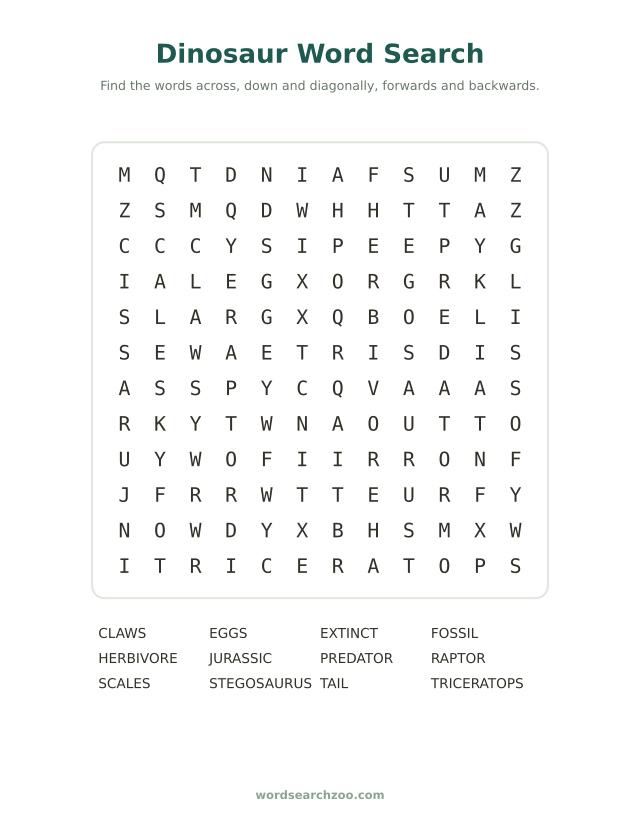
The 12x12 board on this page
The board above as a printable sheet: TRICERATOPS and STEGOSAURUS are the eleven letter giants that almost do not fit, and TAIL is four letters that will hide behind half the grid until the end.
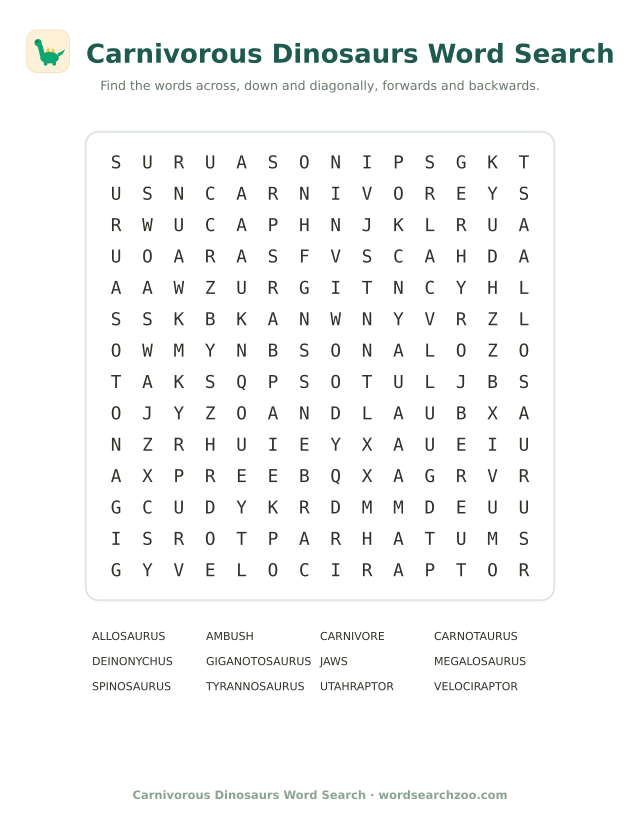
The carnivores, 14x14: the ones with the teeth
A 14x14 board because GIGANOTOSAURUS is fourteen letters: tyrannosaurus, allosaurus, spinosaurus, velociraptor, carnotaurus, deinonychus, utahraptor and megalosaurus, plus the ambush and the jaws.
The herbivores: the ones with the necks
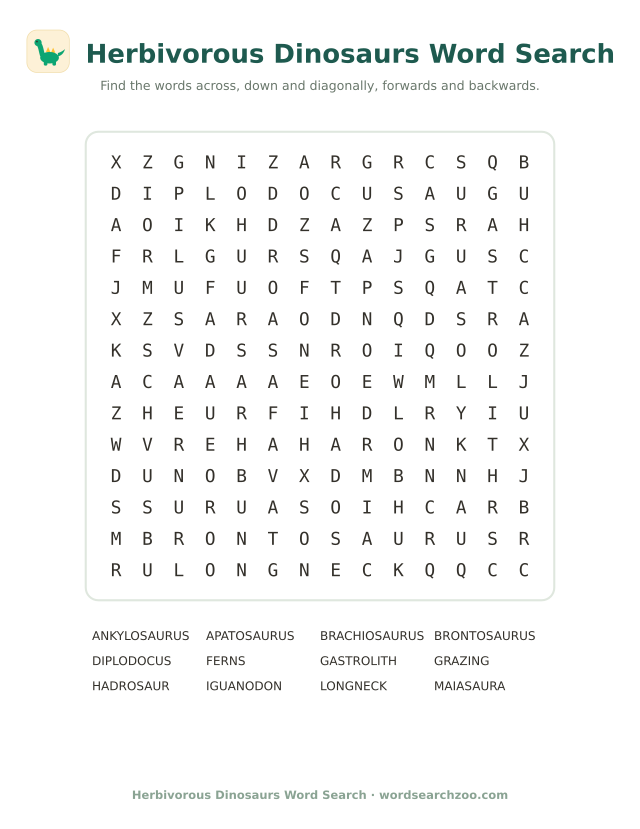
The other half of the diet, on a 14x14 board: brachiosaurus, diplodocus, apatosaurus, ankylosaurus, iguanodon, the hadrosaur, maiasaura and brontosaurus, plus the grazing, the ferns and the gastrolith swallowed to grind them.
The periods: where Jurassic actually sits
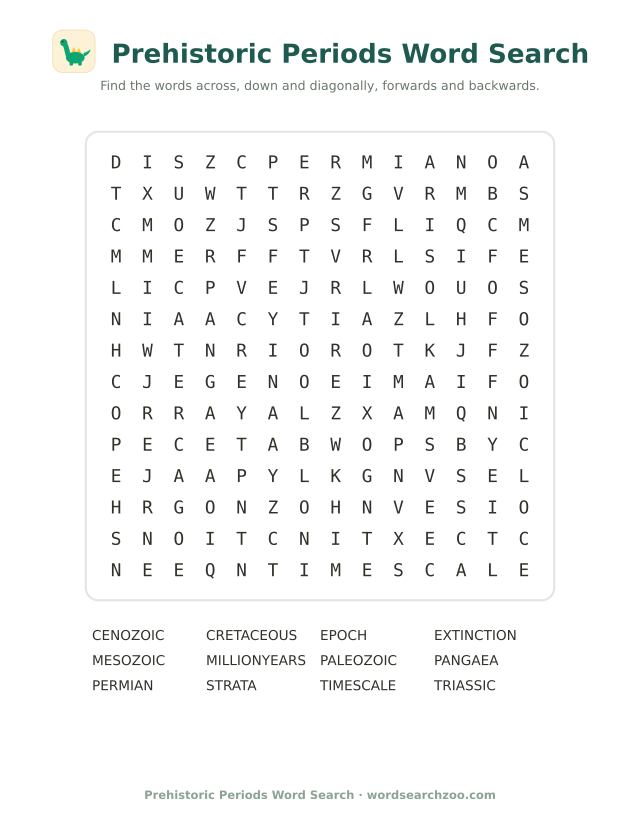
A 14x14 board that puts the famous word in context: the Triassic before it and the Cretaceous after, inside the Mesozoic, after the Paleozoic and the Permian, with Pangaea, the strata, the epoch and the extinction at the end.
The dig: how any of this is known
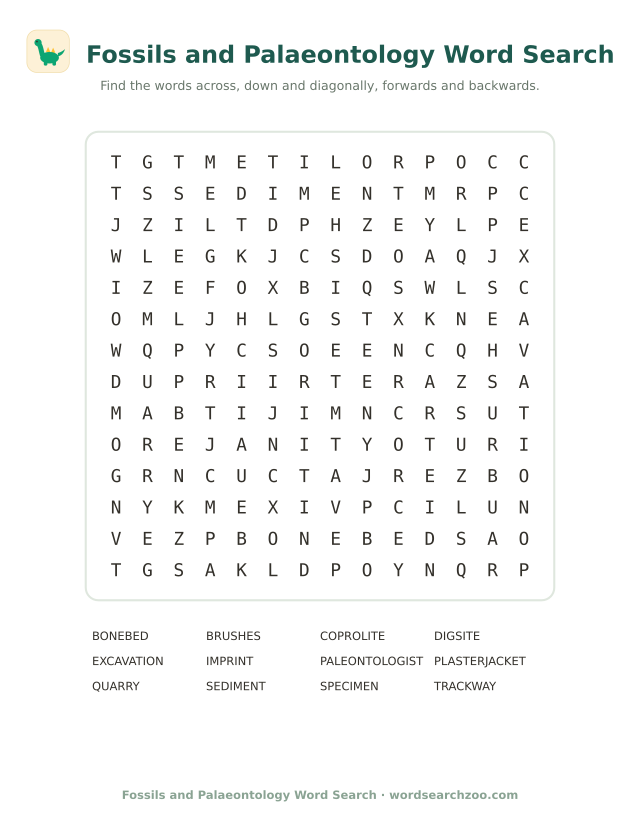
A 14x14 board about the work rather than the animal: the palaeontologist, the dig site, the excavation, the quarry, the sediment, the brushes, the plaster jacket, the specimen, the bone bed, the trackway and the coprolite.
Sea and sky: the ones that were not dinosaurs
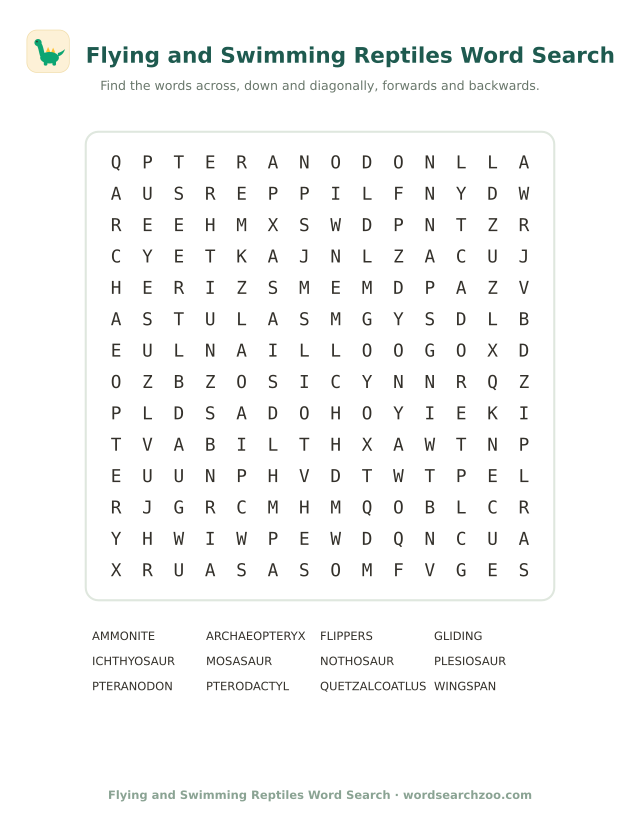
The correction board, 14x14 and worth making: the pterodactyl, the pteranodon, quetzalcoatlus, the plesiosaur, the ichthyosaur, the mosasaur, the nothosaur, archaeopteryx and the ammonite, plus the wingspan and the flippers.
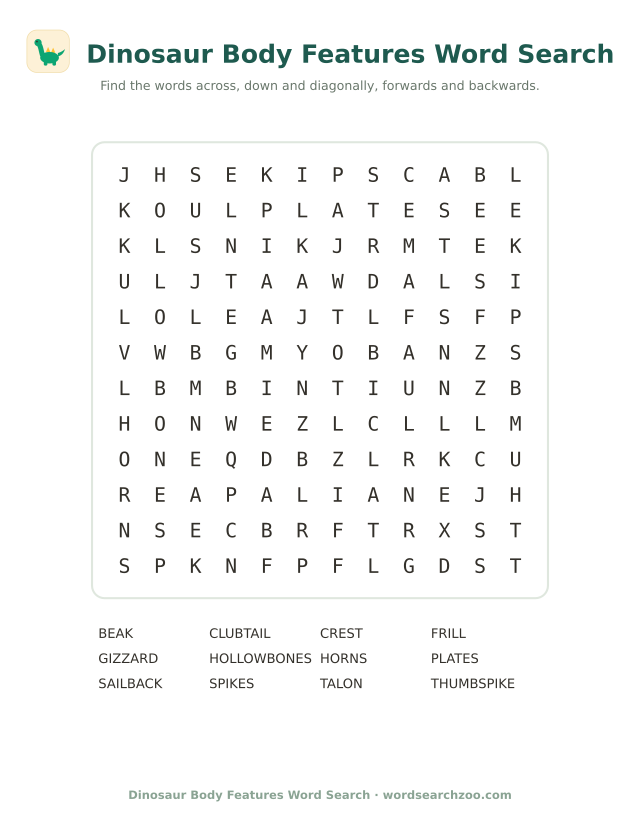
The body: how you tell one from another
The smallest board here, 12x12, and the one that teaches the most: the frill, the horns, the plates, the spikes, the beak, the crest, the talon, the club tail, the sail back, the thumb spike and the hollow bones.