
Flower word search
Twelve flowers are hidden in this grid, from a four letter rose to a whole sunflower. This one uses all eight directions, so the words run diagonally and backwards too.
Curated by  Esme Rook
·
Updated October 2026
Esme Rook
·
Updated October 2026
Play it right here
Drag across the letters to select a word. Words hide across, down and diagonally, forwards and backwards. Works with mouse and touch.
What flowers are hidden in this word search?
Twelve of them in a 12x12 grid: rose, tulip, daisy, sunflower, lily, orchid, daffodil, poppy, violet, jasmine, marigold and petunia. SUNFLOWER and DAFFODIL are the long anchors and the sensible first finds, because a long word has fewer places it can possibly fit. LILY is the sneak, with its repeated letters.
How hard is it, and what age is it for?
Every one of the eight directions is in play on this board, so words hide diagonally and backwards as well as across and down. That makes it a fair hunt from about age 8 upward, and still a pleasant few minutes for an adult. For younger children, the easy word search keeps its words across and down only.
Can I print it for a class or a garden club?
Yes. Both PDFs are free with no sign up: one sheet for the puzzle and a separate one for the solution, so you can hand out the grid without the answers. It prints clean in black and white on ordinary paper. If the bouquet you have in mind is the one that gets thrown, the wedding word search takes it from there across seven printable boards.
One bloom is missing from this board on purpose. The cempasúchil, the marigold whose petals get laid in a path to the front door, hides on the Día de Muertos word search instead.
Seven flower word searches to print, and only one of them is a list of names
The board on this page already holds the twelve flowers everybody can name, and the spring word search holds the bulbs and the blossom, so naming more would just have made a longer version of the same sheet. These six go elsewhere instead: the anatomy of a single flower, the hedgerow, the tropics, the trees that flower, the ones you can smell from the gate and the meanings the Victorians gave them. Two word terms run together on the grid: bird of paradise is BIRDOFPARADISE, cherry blossom is CHERRYBLOSSOM, forget me not is FORGETMENOT.
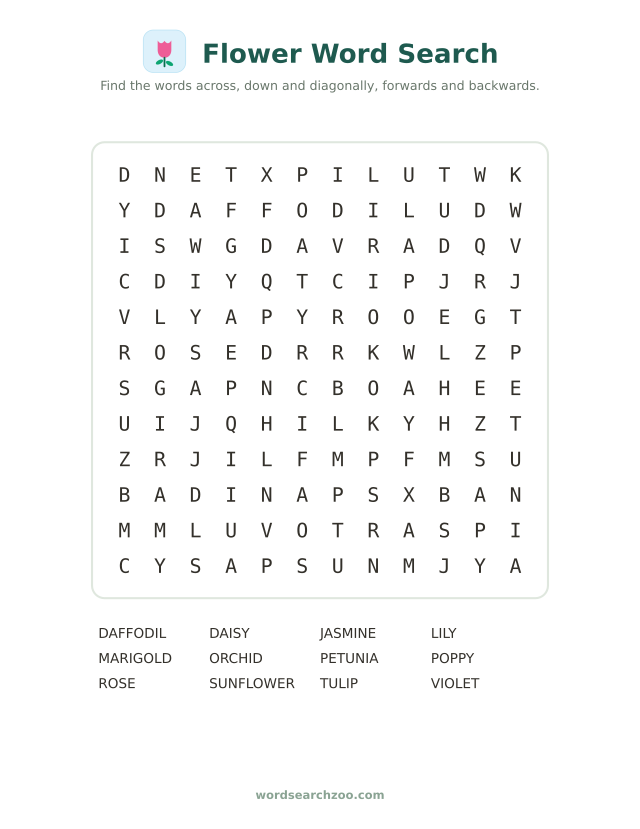
The 12x12 board on this page
The playable board above, printed as it stands: the twelve flowers a florist sells most of, with SUNFLOWER as the nine letter anchor and LILY hiding among a grid full of I and L.
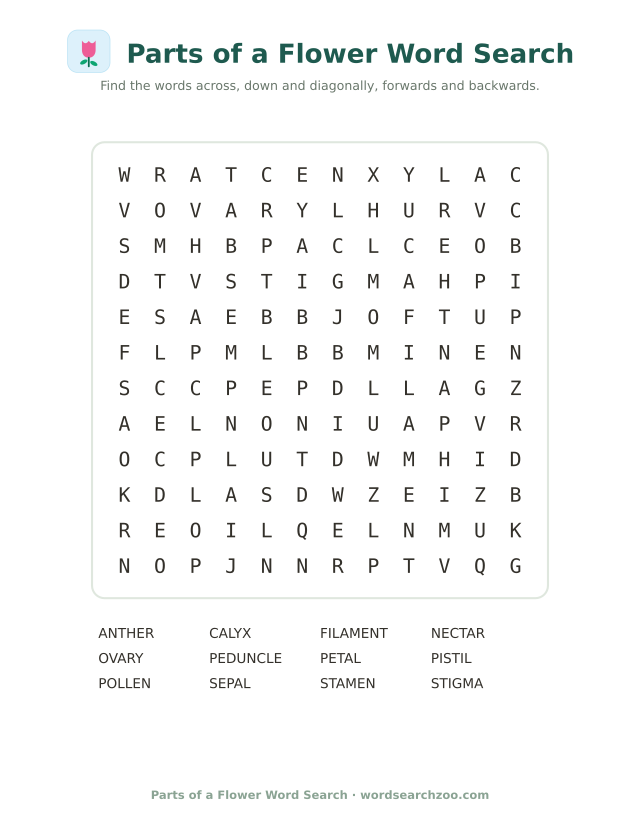
Inside one flower: the parts, named
A 12x12 board that takes a single flower apart in all eight directions: the petal, the sepal, the stamen and its anther, the pistil and its stigma, the ovary, the filament, the pollen and the nectar at the bottom.
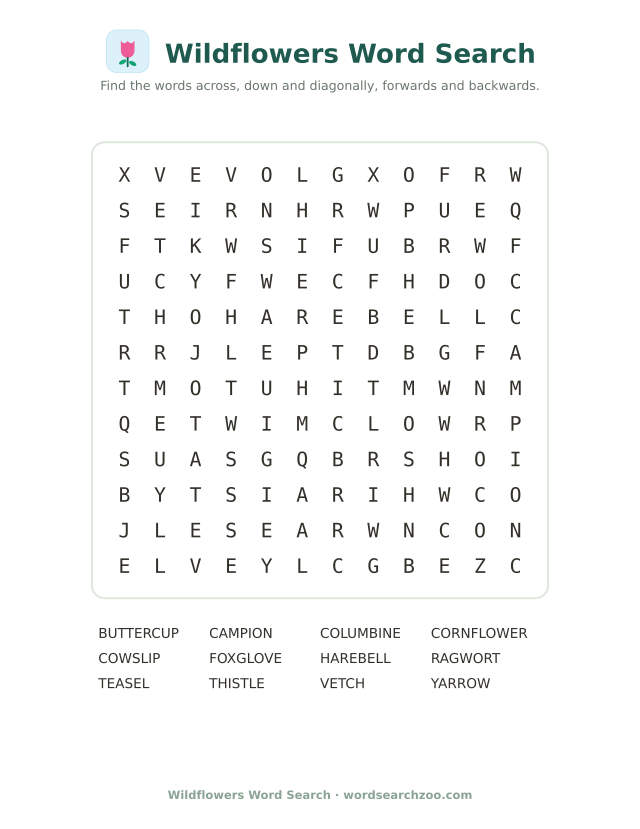
The hedgerow: flowers nobody planted
Twelve flowers off a verge rather than out of a shop, in a 12x12 grid: the buttercup, the cowslip, the foxglove, the columbine, the harebell, the teasel, the thistle and the cornflower.
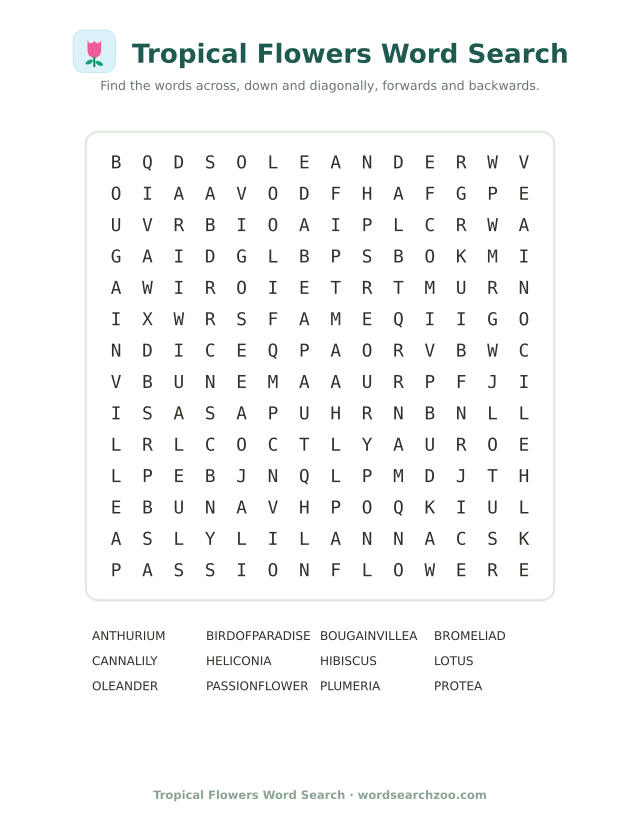
The tropics, 14x14: nothing here survives a frost
A 14x14 board and the only name list of the seven, because none of these grows in a temperate garden: hibiscus, plumeria, bougainvillea, heliconia, anthurium, protea, the passionflower and the bird of paradise.
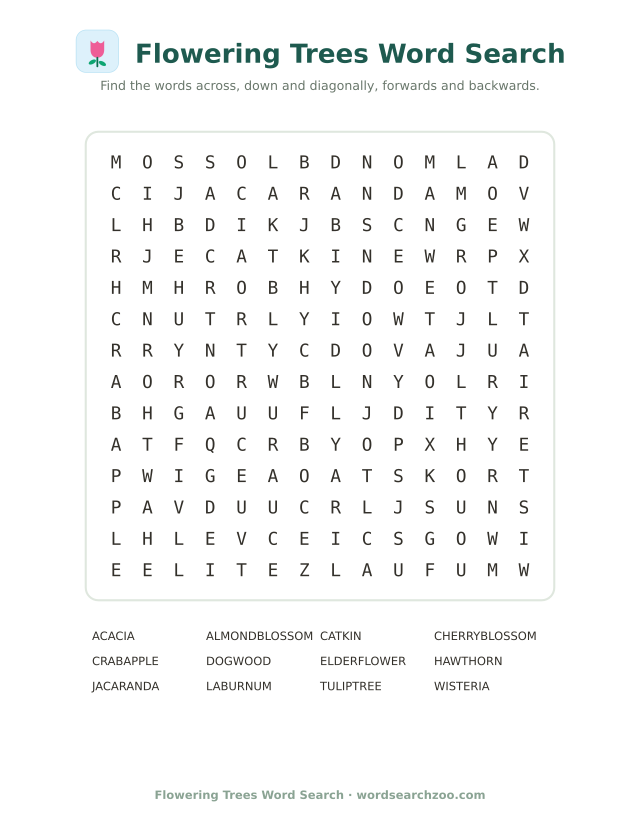
Trees in bloom: the biggest flowers of all
A whole tree is a flower for two weeks a year, and this 14x14 board is those two weeks: the cherry blossom, the almond blossom, the dogwood, the wisteria, the laburnum, the hawthorn and the jacaranda.
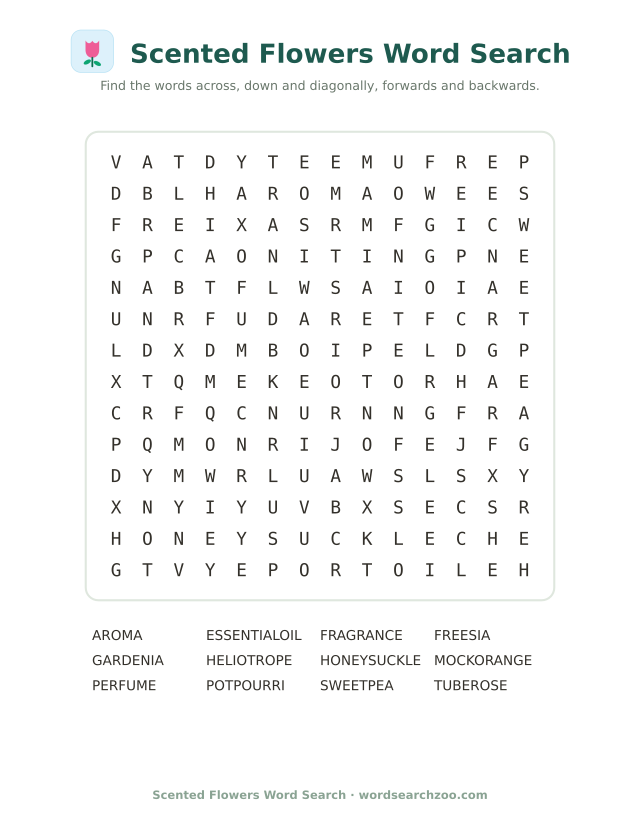
Scent: the half of a flower a picture cannot show
The axis a photograph is useless for, on a 14x14 board: the honeysuckle over a wall, the gardenia, the freesia, the sweet pea, the tuberose, the heliotrope, the potpourri and the essential oil pressed out of them.
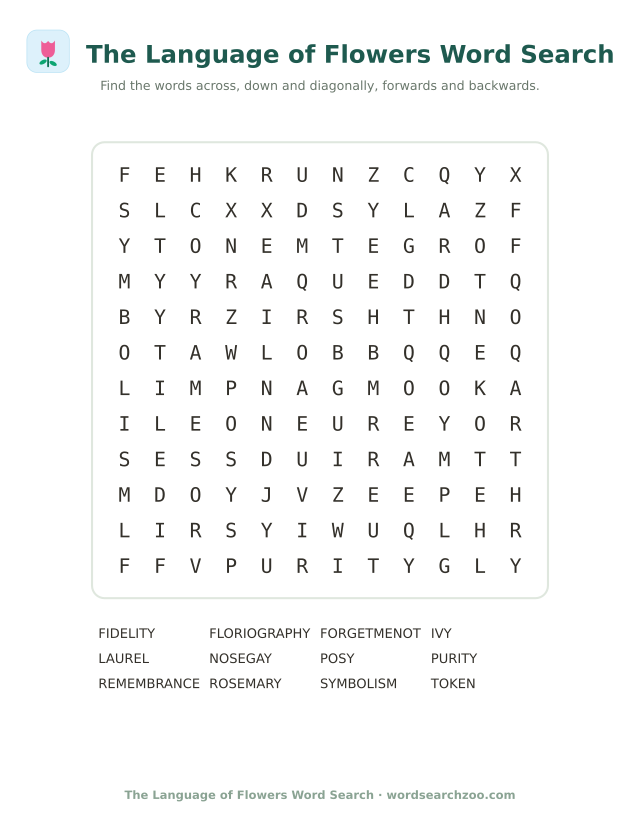
What they meant: the Victorian flower code
For most of the nineteenth century a bouquet was a sentence, and this 12x12 board is its vocabulary: floriography itself, the posy, the nosegay, the ivy for fidelity, the rosemary for remembrance and the laurel for a win.